Description
Key Features
The Quad 303 is chiefly notable for Peter Walker’s innovative “triples” output stage, a quasi-complementary topology that solved the thermal instability problems which plagued many early transistor amplifiers. By employing a feedback arrangement of three transistors per channel, Walker produced an output stage whose resting current remained largely independent of temperature, allowing the amplifier to maintain low distortion under all dynamic conditions. This circuit topology prompted Quad to market the 303 as “the world’s first low-distortion transistor amplifier,” and it remains a defining feature of the design.
The amplifier employs a capacitor-coupled output, which provides inherent DC protection for connected loudspeakers — a practical consideration when using the amplifier with speakers of unknown provenance. The output devices are protected by both voltage and current control, meaning the transistors operate within their ratings at all times without reliance on elaborate protection circuitry.
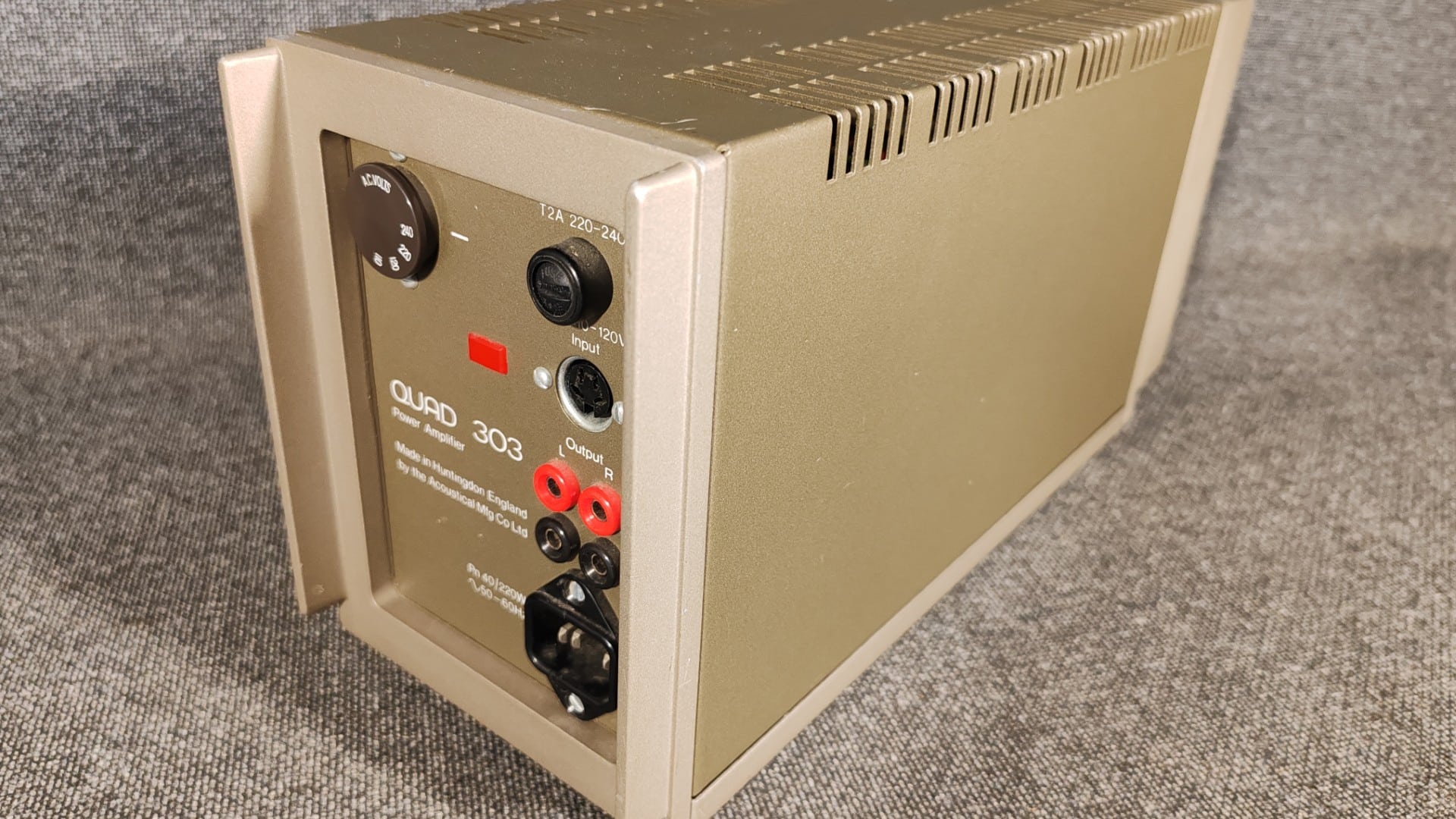
Physically, the 303 adopts a distinctive vertical orientation with prominent front-mounted heatsink fins, allowing it to be tucked away out of sight if desired — a deliberate design choice that paired with the compact Quad 33 control unit to minimise the visual footprint of the system. The casework is finished in the classic Quad grey, and the amplifier was designed to connect to the Quad 33 via a stereo DIN input socket, with loudspeaker connection via 4mm sockets.
Sonically, the 303 is often characterised as warm and smooth in comparison to many transistor amplifiers of its era, offering a presentation that combines the low fatigue of a good valve design with the efficiency and reliability of solid-state circuitry. It was widely adopted not only in domestic settings but also in broadcasting and recording studios, where its dependability and consistent performance were highly valued.
Technical Specifications (Source: HiFi Engine / publicly accessible manufacturer documentation)
-
Type: Stereo power amplifier
-
Power Output: 45 watts per channel into 8Ω
-
Frequency Response: 30Hz–35kHz (-1dB at 30Hz and 35kHz, reference 1kHz, into 8Ω)
-
Distortion (THD): approximately 0.03% at 45W into 8Ω
-
Input: Stereo DIN socket
-
Output: 4mm speaker sockets
-
Output Stage: Quasi-complementary “triples” configuration
-
Year of Production: 1967–1985
-
Country of Origin: United Kingdom
-
Weight: approximately 8.2 kg
-
Dimensions (W × H × D): 120 × 159 × 324 mm
Important Owner’s Notes
The Quad 303 is now over 40 years old and its internal electrolytic capacitors are original. While the amplifier is currently working correctly, a precautionary service — including inspection and replacement of the main electrolytic capacitors — is advisable as part of longer-term ownership, and is something we would be happy to discuss prior to purchase.
The original 303 was designed primarily for 8Ω loudspeaker loads and its output reduces into lower impedances. It is best partnered with moderately efficient speakers of 8Ω nominal impedance. Connectivity is via a stereo DIN input, consistent with its intended pairing with the Quad 33 preamplifier. The amplifier runs warm in normal use and should be positioned with adequate ventilation around the heatsink fins.
Why Buy From Us
With over 40 years of experience in the Hi-Fi industry, we are well placed to assess and test equipment of this type. Every item we list is fully inspected and tested before sale — this unit was checked by Andrew in our workshop.
When you buy from us you can expect:
-
Full inspection and testing prior to listing — not simply a visual check
-
A 3-month guarantee on every item we sell
-
Transparent descriptions with no omissions
-
Professional packaging to ensure safe delivery
-
After-sales support available by phone or email should you have any questions
Summary
This is a particularly well-preserved example of a late-production Quad 303, offered in its original packaging and in excellent cosmetic condition. It represents an opportunity to acquire a piece of British audio history — a design that earned a Council of Industrial Design Award in 1969 and remains celebrated for its innovative circuit topology and musical presentation. Please note that this is a single-unit listing. Please feel free to get in touch with any questions prior to purchase.